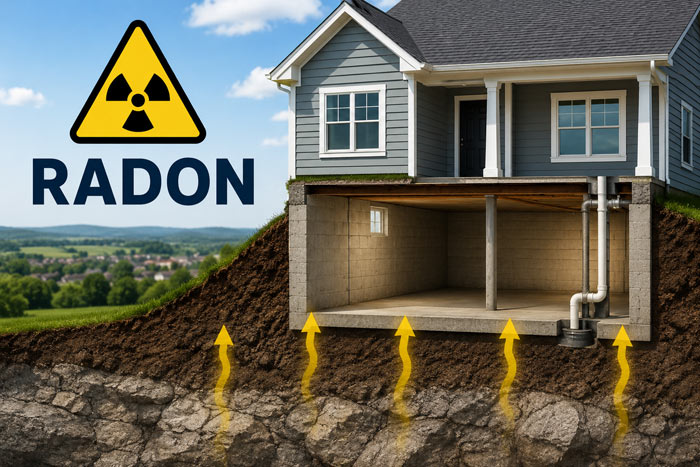
If you’ve spent any time shopping for a home in York County, Pennsylvania, you’ve probably encountered the term radon. Real estate agents mention it during transactions. Home inspectors test for it. Radon mitigation systems are common sights in basements throughout the region.
In my home in Southern York County I’ve used Airthings for many years for monitoring the carbon dioxide levels, humidity, temperature, VOC, and radon levels throughout the levels of my home – and even after the windows are open for multiple hours the radon levels are much higher than they should be (as I write this article the average level is around 5 pCi/L). And this drove me to do some research.
Why is radon such a concern in York County?
The answer lies beneath our feet.
York County’s geology, geography, and soil conditions combine to create an environment where elevated radon levels are surprisingly common. Understanding why can help homeowners make informed decisions about testing, mitigation, and protecting their families.
What Is Radon?
Radon is a naturally occurring radioactive gas that forms when uranium breaks down in rocks and soil.
Because it is colorless, odorless, and tasteless, people cannot detect radon without specialized testing equipment. The gas can move through the ground and enter buildings through cracks in foundations, gaps around pipes, sump pits, crawl spaces, and other openings.
According to the U.S. Environmental Protection Agency (EPA), long-term exposure to elevated radon levels is the second leading cause of lung cancer in the United States and the leading cause among non-smokers.
Pennsylvania Has a Long History of Radon Concerns
Pennsylvania is widely recognized as one of the states with the highest average indoor radon levels in the country.
The state’s awareness of radon dates back to the 1980s when elevated radon levels were discovered in homes and workplaces throughout the region. Since then, extensive testing has shown that many Pennsylvania counties experience radon concentrations above the EPA’s recommended action level of 4.0 picocuries per liter (pCi/L).
York County consistently ranks among the areas where elevated readings are common.
The Geology Beneath York County
The primary reason York County experiences elevated radon levels is its underlying geology.
Large portions of York County sit atop rock formations that naturally contain uranium-bearing minerals. As uranium slowly breaks down over time, radon gas is released into surrounding soils.
Several geological formations found throughout south-central Pennsylvania are known to produce higher levels of radon than many other regions of the country.
York County’s landscape includes areas of:
- Limestone
- Dolomite
- Schist
- Gneiss
- Various metamorphic rock formations
These rock types often contain naturally occurring radioactive elements that contribute to radon production.
The result is a steady generation of radon gas beneath many homes and buildings throughout the county.
Fractured Rock Creates Easy Pathways
Producing radon is only part of the story.
The gas must also have a way to travel.
Many of York County’s rock formations contain fractures, cracks, and joints that allow radon gas to move relatively easily through the ground. These natural pathways can channel radon toward the surface where it may enter homes.
In some locations, underground water movement has also created additional openings and voids in rock formations, further increasing the potential for radon migration.
Soil Conditions Matter Too
Certain soil characteristics can make radon problems more likely.
Soils that are loose, porous, or well-drained often allow radon gas to move more freely toward the surface. York County contains many areas where soil conditions facilitate this movement.
As a result, radon generated deep underground can migrate upward and accumulate beneath homes and buildings.
When a house creates lower air pressure than the soil beneath it, the building can effectively draw radon gas inside.
Why Basements Are Especially Vulnerable
Most York County homes have basements.
Unfortunately, basements create ideal conditions for radon entry.
Because basements are below ground level, they are in direct contact with the surrounding soil. Small openings that seem insignificant can allow measurable amounts of radon to enter a structure over time.
Common entry points include:
- Foundation cracks
- Construction joints
- Utility penetrations
- Sump pits
- Floor drains
- Crawl spaces
- Gaps around support posts
Even well-built homes can experience elevated radon levels.
In fact, a newer home can sometimes have higher radon readings than an older home depending on its construction methods, ventilation patterns, and location.
Radon Levels Can Vary Dramatically From House to House
One of the most surprising aspects of radon is its unpredictability.
A home may have very high radon levels while a neighboring property just a few hundred feet away tests well below recommended limits.
This occurs because radon concentrations are influenced by numerous factors, including:
- Local geology
- Soil conditions
- Foundation design
- Ventilation patterns
- Weather conditions
- Seasonal changes
- Building construction techniques
For this reason, experts recommend testing every home individually rather than assuming a property’s radon level based on nearby houses.
York County’s Mix of Rural and Suburban Development
York County’s development patterns may also contribute to radon concerns.
Many homes are built on former farmland or semi-rural properties where large tracts of undisturbed soil remain beneath structures. Depending on the geological conditions present, these sites can provide a continuous source of radon gas.
As communities expand throughout southern and central York County, new construction often occurs in areas with the same underlying geological characteristics that have historically produced elevated radon readings.
The Good News: Radon Can Be Managed
While elevated radon levels can sound alarming, there is good news.
Radon is one of the most manageable environmental hazards homeowners face.
Testing is relatively simple and affordable. If elevated levels are found, professional mitigation systems can often reduce indoor radon concentrations dramatically.
Most mitigation systems work by creating negative pressure beneath the foundation and safely venting radon gas above the roofline before it enters living spaces.
Modern mitigation systems are generally effective, reliable, and designed to operate continuously with minimal maintenance.
Should York County Homeowners Test for Radon?
The short answer is yes.
Because radon levels can vary significantly even between neighboring homes, testing remains the only way to know whether a property has elevated radon concentrations.
Testing is particularly important for:
- Homebuyers
- Home sellers
- Families with finished basements
- Owners of older homes
- Owners of newly constructed homes
- Anyone who has never tested their property
Even if a home tested safely years ago, periodic retesting may be worthwhile because conditions can change over time.
Takeaways
York County’s elevated radon levels are not the result of pollution, industrial activity, or poor construction practices. Instead, they stem largely from the county’s natural geology and soil conditions.
The same geological features that help define the region’s landscape also contribute to the generation and movement of radon gas beneath homes and buildings.
Fortunately, awareness, testing, and modern mitigation technology make it possible for homeowners to identify and address radon concerns effectively.
For York County residents, understanding the local geology is the first step toward understanding why radon remains an important part of home ownership and real estate conversations throughout the region.
Leave a Reply